

 (210) 610.2332
In a fast-paced world, homeowners and businesses are looking for easy-to-use, efficient, and environmentally friendly solutions for heating and cooling. Conventional HVAC systems, with bulky ductwork and energy-intensive operation, often struggle to meet modern comfort needs. Many people start researching what a ductless mini split is and how it works when they notice rising energy bills, uneven temperatures, or frequent system maintenance. This is where ductless mini split systems offer a practical and reliable alternative.
Ductless mini splits not only replace outdated systems but also address common problems in traditional heating and cooling units. From air loss through duct leaks to inconsistent room temperatures, these issues can affect both comfort and efficiency. A ductless HVAC system is designed to overcome these challenges by delivering targeted heating and cooling exactly where it’s needed. Understanding what a ductless mini-split is and how it works can help you see why it has become a popular choice for modern homes and businesses.
What is a Ductless Mini Split?
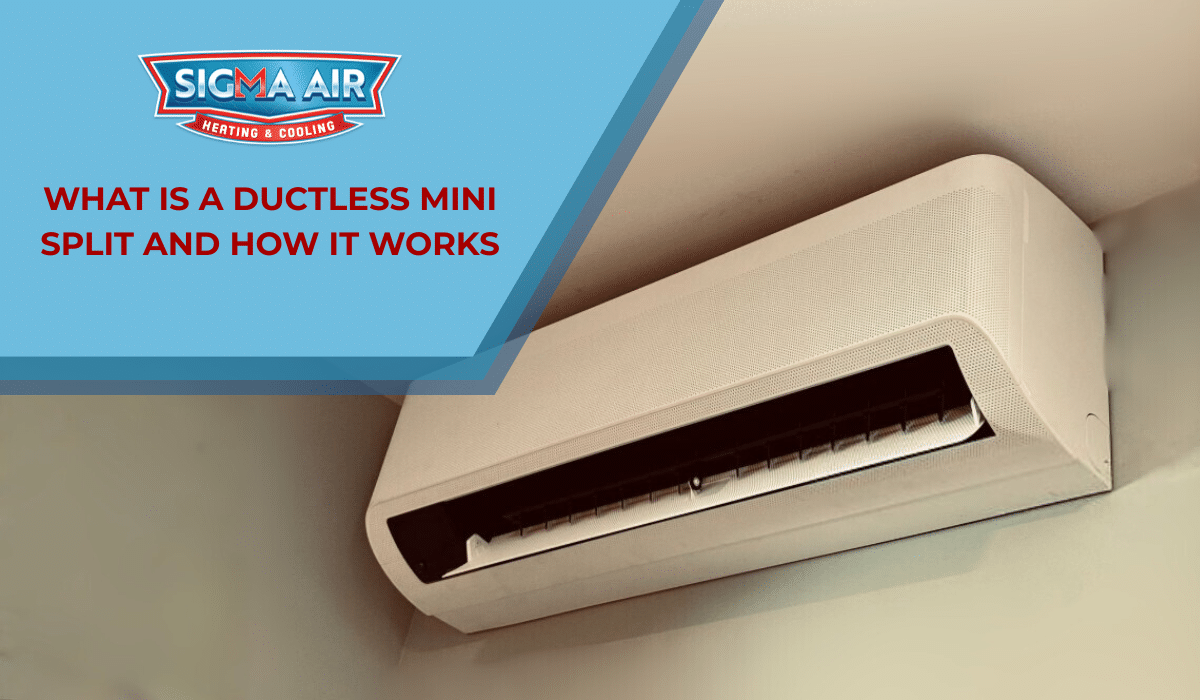
Unlike traditional systems that use ducts to deliver air from a central unit, a ductless mini-split system heats or cools a space without ductwork. This ductless system delivers cooled or heated air to every room or zone, provided each room or zone has an indoor unit.
This has led the system to gain popularity among homes and businesses, as it is cost-effective, flexible, and designed to provide comfort to a room or zone rather than the entire building. Its ease and efficiency have made it particularly effective for retrofitting buildings that were never designed to be ducted, as well as for homeowners and business owners seeking greater control over their heating and cooling.
Main Parts of a Ductless Mini Split
The various components of a ductless mini split system all work together to ensure comfortable temperatures in your home or business:
-
Outdoor Unit (Compressor/Condenser)
The compressor and condenser are contained in the outdoor unit. It is usually located outdoors and compresses the refrigerant while expelling heat from the indoor air. The compressor circulates refrigerant through the circuit, where it absorbs or releases heat. The condenser adds or removes heat from the process.
-
Indoor Unit (Air Handler)
The air handler (also called the indoor unit) is mounted inside the room or home. This unit conditions, chills, or heats the air. The evaporator coil is located in the indoor unit and absorbs or releases heat to the air. The air handler includes an integral fan that delivers conditioned air to the occupied space. It also features filters that help remove dust, allergens, and other airborne particles from your home’s air.
-
Refrigerant Lines
These are copper fittings that join the indoor and outdoor units. The refrigerant cycles through these pipes, exchanging heat between the outdoor and indoor equipment. The refrigerant changes from a liquid to a gas between the heat exchanger and the liquid/fluid condition, improving its efficiency in both heat absorption and heat rejection.
-
Electrical Connections
These are the electrical lines for both the outdoor and indoor units. The electronic system is essential for the units to communicate and work properly. It drives the compressor, fan, and other system components.
-
Remote Control or Thermostat
Ductless mini-splits. Depending on the model, many ductless mini-split systems include either a slim remote control or a wall-mounted thermostat to control temperature settings in each zone. This is an essential part of a ductless system because it allows you to control each room’s temperature independently.
How Does a Ductless Mini Split Work?
A ductless mini-split system is an ideal way to heat and cool your home without relying on outdated, energy-intensive ductwork. This system uses heat exchange of the refrigerant and provides an adaptable, energy-efficient method for treating indoor air. Here’s a more detailed explanation of how a ductless mini-split works in cooling and heating modes.
Cooling Mode
For cooling your home, a ductless mini-split operates similarly to a conventional air conditioner: once you turn it on, it removes hot air from the house.
Here’s how the process works:
- Warm-air indoor unit fan: The indoor unit’s fan draws in warm air from the room. The air is then cycled over the evaporator coil, which contains refrigerant that absorbs heat from the air. The refrigerant cycle causes the low-pressure, cold liquid to become high-pressure, warm gas when it is exposed to the warmer air in the coils.
- Outdoor unit heat rejection: The refrigerant, carrying absorbed heat, is then routed through the refrigerant lines to the outdoor unit. This unit contains the compressor, which increases the refrigerant’s pressure and temperature.
- The refrigerant gives off heat: As the high-pressure, warm refrigerant gas moves through your outdoor unit, it is cooled as it passes through the condenser coil. This heat is released back into the outside air. The refrigerant is then cooled and condensed to the liquid phase.
- Cycle repeats: The chilled refrigerant is then pumped back into the indoor unit to adsorb more heat, and the cycle repeats, pumping chilled air into the room. This mechanism not only provides a steady stream of cool air but also consumes far less energy.
Heating Mode
When in heating mode, a ductless mini-split unit operates in the opposite way from cooling mode. Rather than cooling the inside of your home, the system draws heat from outside (yes, even in cold weather) and transfers it indoors. Here’s how heating works:
- Heat absorption: In heating mode, the compressor in the outdoor unit reverses refrigerant flow. The outdoor coil becomes the evaporator coil. As there is no heat load, the system works like a standard air conditioner. When the refrigerant arrives at the outdoor unit, it is a cold, low-pressure liquid.
- Refrigerant goes to the indoor unit: The refrigerant then flows through the lines and enters the indoor unit as hot gas. In this case, refrigerant cannot be fed to the outdoor evaporator coil (the condenser coil in heating) unless the outdoor ambient temperature exceeds the indoor air-source temperature.
- Heat is released inside: As the air blows across the indoor coil, the heat from the refrigerant is absorbed and then released. That warm air is then recirculated into the room by the fan in the air handler. Cooled, the refrigerant returns to your outdoor unit, where it absorbs more heat, and the cycle starts over.
- Constant temperature transfer: This ensures you stay comfortable while playing. Because they source their heat from the air (even when outdoor temperatures are very low), these systems can be remarkably efficient even in colder climates.
Zoning and Control
One of the most important benefits of ductless mini-splits is zoning. Each indoor unit can operate independently, delivering air conditioning only to the rooms that need it. This feature of the zoning has several advantages:
- Energy saver: Keep your home comfortable while conserving energy by heating or cooling only the rooms in use.
- Personalized comfort: For those who prioritize different temperatures in different rooms, two temperature ranges can be set to maintain optimal comfort. In other words, you can choose to have a cooler bedroom and a warmer living room without feeling any less comfortable.
- Flexibility: Because one outdoor unit can be connected to multiple indoor units, a system can be easily tailored for any home, from a single room to several rooms on one floor or an entire floorspace.
Understanding the benefits of ductless mini-split systems helps explain why countless homeowners choose this system over traditional AC or heating systems. Because these systems blow cool or warm air directly into the room, they use less energy. They simply use technology that reduces power consumption and offers better comfort. For them to work properly, it is best to know how often HVAC should be serviced.
Conclusion
What a ductless mini-split is and how it works includes an explanation of accurate control, improved air quality, energy efficiency, and flexible installation options. Whether you are retrofitting an older home or adding a new addition, ductless mini-splits deliver modern comfort without the hassles and energy waste of traditional HVAC.
If it’s time to condition your indoor environment with professional HVAC ductless mini split installation services in San Antonio, TX, trust Sigma Air Heating & Cooling. What sets us apart is the combination of service and deep technical specialisation. Our skilled technicians are dedicated to customized service, meticulous workmanship, and lasting results, not short-term fixes.
Are you ready to step up to a high-performance system with professional services from an HVAC Company in San Antonio, TX, and an energy-saving ductless mini-split system? Call us for professional recommendations, accurate installation, and long-term comfort. It all begins with your best indoor climate.